

About Namibia
Namibia
A stable and resource-rich southern African nation offering residency pathways for investors seeking exposure to one of the continent’s most politically secure and economically promising jurisdictions, with vast natural landscapes and a growing economy.
Country Overview
Explore Namibia’s residency by investment program from the program tab, or contact us directly for a private consultation about establishing your presence in one of Africa’s most stable and investor-friendly nations.
Country Information
Strategic Advantages
Why Namibia
Political Stability
One of Africa’s most stable democracies since independence in 1990, with a strong constitutional framework, independent judiciary, free press, and peaceful transitions of power.
Resource-Rich Economy
Major producer of diamonds, uranium, and critical minerals, with growing sectors in green hydrogen, renewable energy, and oil and gas exploration driving significant foreign investment.
Emerging Green Hub
Namibia is positioning itself as a global leader in green hydrogen production, attracting billions in planned investment and offering early-mover advantages for strategic investors.
Affordable Property
Foreign nationals can own freehold property in Namibia at highly competitive prices, with opportunities spanning urban residential, commercial, and agricultural land holdings.
An Introduction to Namibia
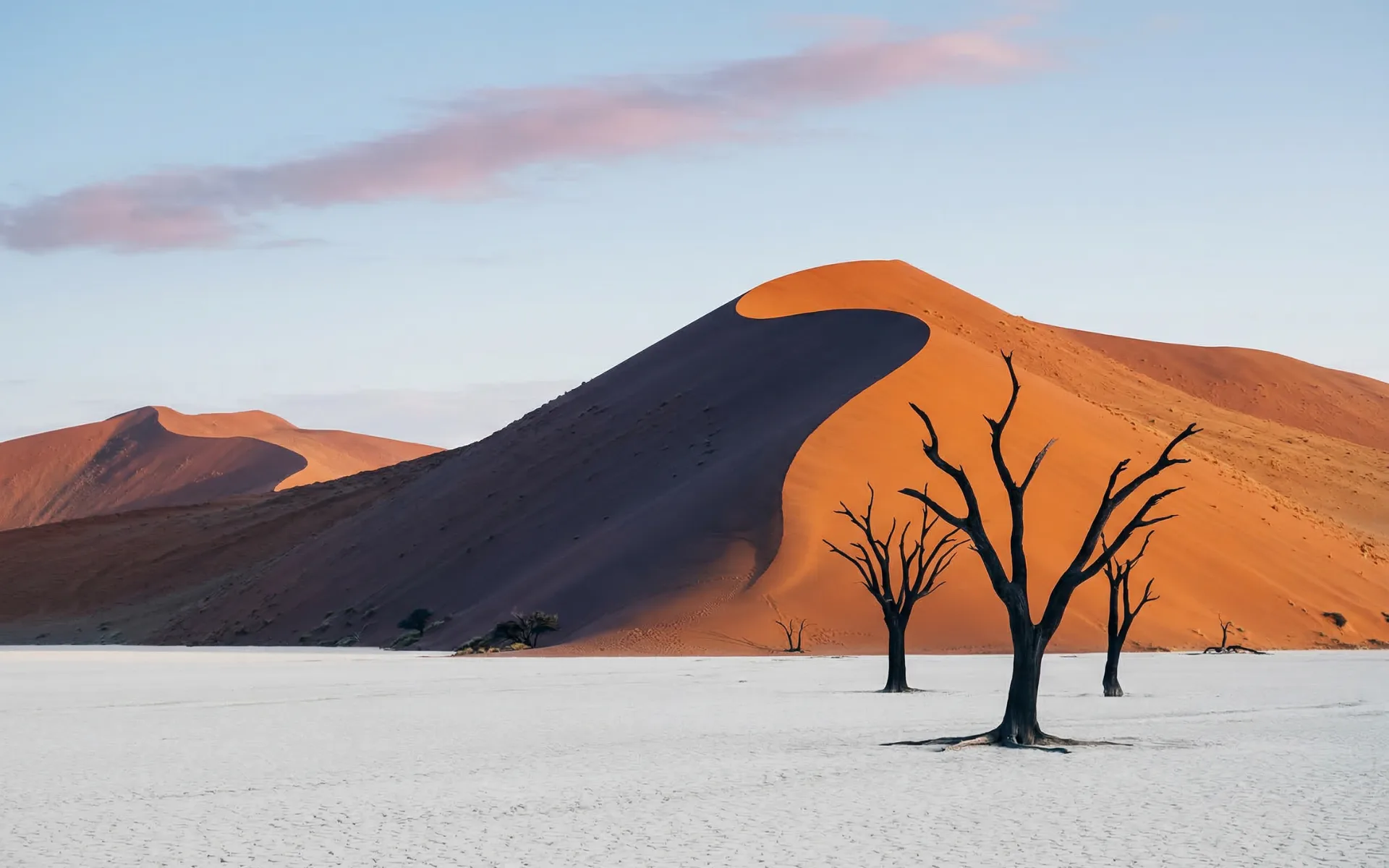
The Republic of Namibia is a vast country in southwestern Africa, bordered by Angola, Zambia, Botswana, South Africa, and the Atlantic Ocean. With a land area of 824,292 square kilometres and a population of just 2.6 million, Namibia is one of the least densely populated countries in the world, offering extraordinary open landscapes that range from the Namib Desert — one of the oldest deserts on earth — to the wildlife-rich Etosha National Park and the dramatic Skeleton Coast.
Namibia gained independence from South Africa in 1990 and has since established itself as one of the continent’s most stable and well-governed nations. The country operates as a multi-party parliamentary democracy with a strong constitution that guarantees fundamental rights and freedoms. The World Bank and International Monetary Fund consistently rate Namibia highly for governance, press freedom, and rule of law.
The Namibian economy is driven primarily by mining, with the country being the world’s fifth-largest producer of uranium and a significant producer of gem-quality diamonds through the Namdeb partnership with De Beers. Agriculture, fishing, and tourism are also important contributors. In recent years, Namibia has attracted global attention for its green hydrogen ambitions, with projects worth billions of dollars in development that aim to make the country a major exporter of clean energy.
Namibia’s residency programme for investors requires establishing a qualifying business or making a significant investment in the country. The process is administered through the Ministry of Home Affairs, Immigration, Safety, and Security. Applicants must demonstrate that their investment will create employment and contribute to Namibia’s economic development. Work and residency permits are typically granted for periods of up to five years and are renewable.
Windhoek, the capital, is a clean, modern, and safe city with a distinctly German-influenced architecture reflecting Namibia’s colonial history. The city offers good international schools, private healthcare facilities, shopping centres, and a growing culinary scene. English is the official language, making business and daily life accessible for international residents.
Namibia’s tax system includes a progressive personal income tax with a top rate of 37%, and corporate tax at 32%. However, the country offers incentives for manufacturers, exporters, and businesses operating in special economic zones. Namibia has double taxation agreements with several countries, and its membership in the Southern African Customs Union (SACU) provides preferential trade access across the region.

At a Glance
Key Facts
75+
Visa-Free Destinations
Namibian passport holders enjoy visa-free or visa-on-arrival access to over 75 countries across Africa, Asia, and the Americas.
NAD 10M+
Qualifying Investment
Business investment creating employment and contributing to economic development qualifies investors for residency permits.
824,292 km²
Total Land Area
One of Africa’s most spacious countries with vast agricultural, mining, and conservation land available for investment.
5th
Global Uranium Producer
A major producer of uranium, diamonds, and critical minerals, with emerging opportunities in green hydrogen and renewable energy.
Top 5
African Governance
Consistently ranked among Africa’s best-governed nations for democracy, press freedom, rule of law, and transparency.
300+
Days of Sunshine
Over 300 days of sunshine annually, supporting both an exceptional outdoor lifestyle and the country’s renewable energy ambitions.
Investment Pathways
Available Programs
Residency by Investment
Namibia Investor Residency
Obtain residency in Namibia through a qualifying business investment that creates employment and contributes to the nation’s economic development, with potential for permanent residency.
Explore program —→Real Estate Investment
Namibian Property Market
Invest in Namibian real estate from Windhoek urban developments and coastal properties in Swakopmund to agricultural land and tourism lodge opportunities across the country.
View properties —→Common Questions
Frequently Asked Questions
How can I obtain residency in Namibia through investment?
Namibia offers residency permits for foreign nationals who make qualifying business investments in the country. The investment must create employment for Namibian citizens and contribute to economic development. Applications are processed through the Ministry of Home Affairs, Immigration, Safety, and Security. Initial work and residency permits are typically granted for up to five years and are renewable. After a sustained period of legal residence, investors may apply for permanent residency.
Can foreigners own property in Namibia?
Yes. Foreign nationals can own freehold property in Namibia, including residential, commercial, and industrial properties. Agricultural land ownership by foreigners is subject to certain restrictions under the Agricultural (Commercial) Land Reform Act, which gives the government a right of first refusal on agricultural land sales. Urban and commercial property purchases are straightforward with a well-established conveyancing system based on Roman-Dutch law.
Is Namibia safe for expatriates?
Namibia is generally considered one of the safer countries in Africa for expatriates. Windhoek and other major towns have established security infrastructure, and the country benefits from political stability and a strong rule of law. As with any country, standard precautions are advisable. The expatriate community, while relatively small, is well-established, particularly in Windhoek, Swakopmund, and the tourism regions.
What investment sectors are most attractive in Namibia?
Namibia offers compelling investment opportunities across several sectors. Green hydrogen is the most significant emerging opportunity, with projects worth billions planned along the coast. Mining remains a cornerstone, with diamonds, uranium, and critical minerals. Tourism presents opportunities in lodge development and conservation. Agriculture and fisheries are stable sectors, while manufacturing benefits from special economic zone incentives. The government actively encourages foreign investment in these areas.
Can Namibia residency lead to citizenship?
Namibian citizenship by naturalisation is available to foreign nationals who have held permanent residency and been ordinarily resident in the country for a qualifying period, typically at least five years after obtaining permanent residency. Applicants must demonstrate good character and integration into Namibian society. Dual citizenship provisions are limited, and applicants should consult with TopNation Global regarding the specific requirements applicable to their nationality.

Specialist Services
How we work in Namibia
Residence by Investment
Residence-permit advisory for Namibia and other qualifying jurisdictions.
Learn more →Citizenship by Investment
Programmes leading to a second passport, including options relevant to Namibia.
Learn more →Investment Real Estate
Curated qualifying properties in Namibia and 21 other markets.
Learn more →Strategic Advisory
Senior-led, jurisdiction-agnostic engagement for complex situations.
Learn more →